

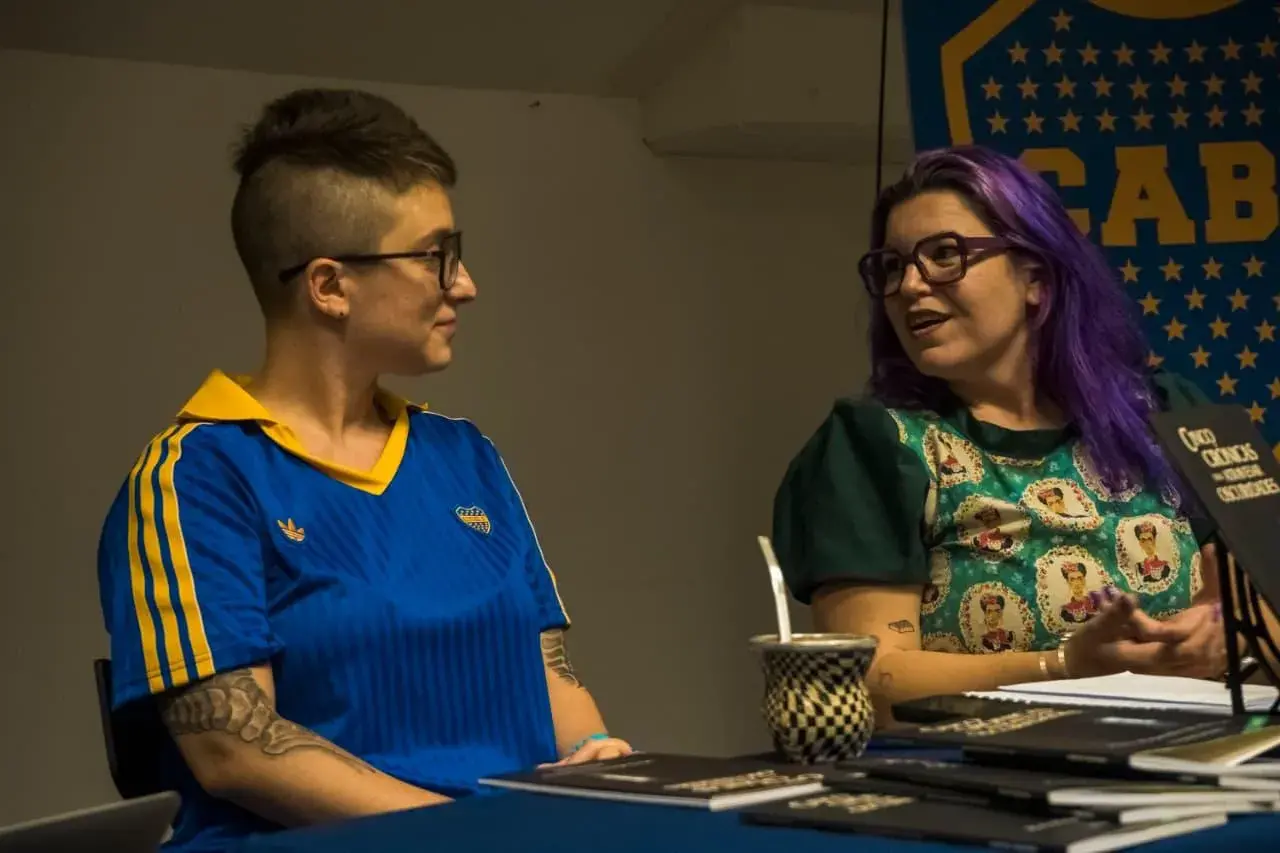
Institution: Boca Juniors Athletic Club
Gender-Based Analysis of Five Chronicles to Navigate Darkness by María Alejandra de Antoni
Literature has the unique ability to illuminate realities that often remain invisible. In Five Chronicles to Navigate Darkness, María Alejandra de Antoni explores experiences of pain, resilience, identity, and transformation through narratives that invite readers to confront the emotional and social complexities of being human. The book also offers fertile ground for a gender-based analysis, allowing us to examine how gender shapes the ways people experience vulnerability, violence, care, and healing. (Instagram)
A gender perspective goes beyond identifying male and female characters. It seeks to understand how cultural expectations, social roles, and power structures influence each person’s experiences and opportunities. In this sense, De Antoni’s work reveals how emotional suffering is not lived in isolation but is deeply connected to social norms surrounding femininity, masculinity, and the expectations placed upon individuals.
Throughout the five chronicles, readers encounter stories that challenge traditional narratives about strength and fragility. Rather than presenting resilience as the absence of pain, the book portrays healing as a deeply personal and often collective process. This perspective aligns with contemporary gender studies, which emphasize the importance of recognizing emotional labor, caregiving, and vulnerability as fundamental human experiences rather than gendered obligations.
Another significant contribution of the book lies in its capacity to give voice to experiences that are frequently marginalized. By centering intimate stories and emotional realities, Five Chronicles to Navigate Darkness questions dominant narratives that have historically minimized or silenced certain perspectives, particularly those of women and other historically underrepresented groups. The chronicles invite readers to reconsider whose stories are told, whose suffering is acknowledged, and whose resilience is celebrated.
The work also encourages reflection on the intersection between personal trauma and broader social contexts. Darkness, in De Antoni’s writing, is not merely an individual condition but often reflects structural inequalities, emotional isolation, and the consequences of rigid social expectations. Through this lens, the book becomes not only a literary experience but also a space for dialogue about empathy, inclusion, and social justice.
Ultimately, Five Chronicles to Navigate Darkness demonstrates that literature can be a powerful tool for examining gender dynamics without reducing characters to stereotypes or simplistic categories. Instead, it offers nuanced portraits of human complexity, reminding us that understanding gender is essential for understanding how people navigate adversity, relationships, and personal transformation.
By approaching the book through a gender-based lens, readers gain a richer appreciation of its emotional depth and its broader social significance. María Alejandra de Antoni’s chronicles invite us not only to witness stories of darkness but also to recognize the diverse paths through which individuals reclaim agency, dignity, and hope.